Design Widget
Brand-aligned image generation through DSL constraints, not open-ended prompting
The Shiny
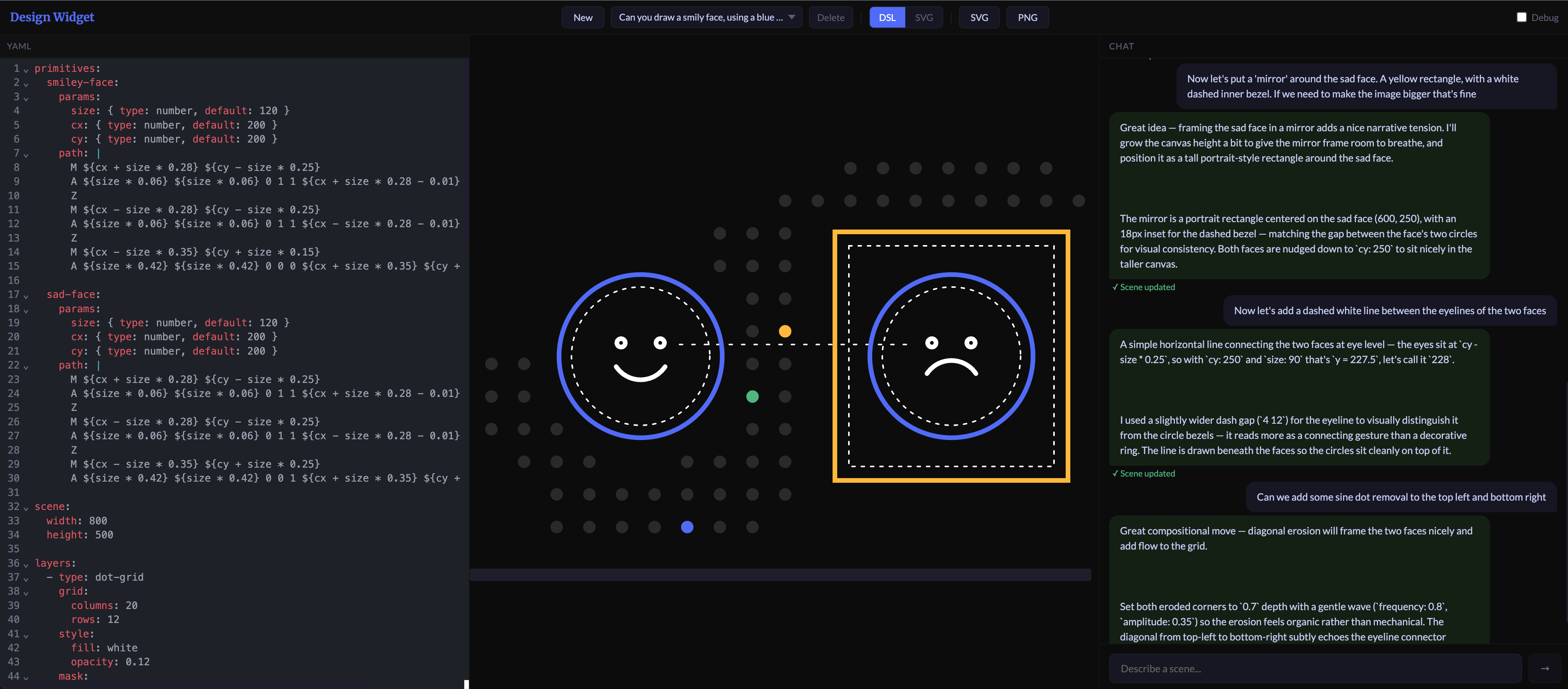
Marketing teams need visuals fast. Nano Banana and similar tools can generate anything — which is exactly the problem. Design Widget constrains the creative space through a domain-specific language (DSL) — a simplified, purpose-built syntax that encodes brand rules: color palette, typography, composition grids, and asset library. A model generates DSL instructions, and a renderer turns them into final images. The team gets speed without sacrificing brand coherence, and the generation model never needs to freestyle.
The Hard Stuff
The core challenge is designing constraints that are tight enough to guarantee brand alignment but loose enough that the output doesn’t feel templated. The DSL has to be expressive without being a programming language — marketing teams need to use it, not engineers. The renderer pattern separates “what to make” from “how to make it,” meaning the generation model never sees raw brand assets or freestyle prompts.
Built With
Claude, Gemini, Custom DSL, Renderer Pipeline
What we learned
We tested whether native SVG generation outperformed our DSL, given SVG's prevalence in training data. For individual figures, SVG is more expressive — but models struggle to produce consistent, rule-following SVG compositions. The DSL's constraints are the feature, not the limitation. Separately: Gemini considerably outperforms Claude and GPT at visual generation tasks. Google's visual capabilities remain a full generation ahead of the competition.
What's on your mind?
We'd love to hear from you.
Reach out to our team at Hello@intentional.team